 Spanish
 English

Choose LEGO model building for educational projects
Nov 04, 2026
Creating LEGO models for educational projects can be very useful if you focus properly on the subject you want to teach. Get your model.
<p>Learning a concept does not always mean having to read about it in a book or listen to someone explain it in class. In many cases, working with materials that students can handle makes it easier for them to understand what they are studying. <strong>Building</strong><a href="https://madeofbrick.com/en/module/owlblog/post?id_owl_blog_post=92&category_parent=1-8-consejos-para-montar-maquetas-personalizadas-de"><strong> LEGO models</strong></a><strong> for educational projects</strong> is a way of putting what they learn into practice, as it allows them to represent ideas, build models and see how different elements work.</p>
<h2>How do LEGO bricks influence educational projects?</h2>
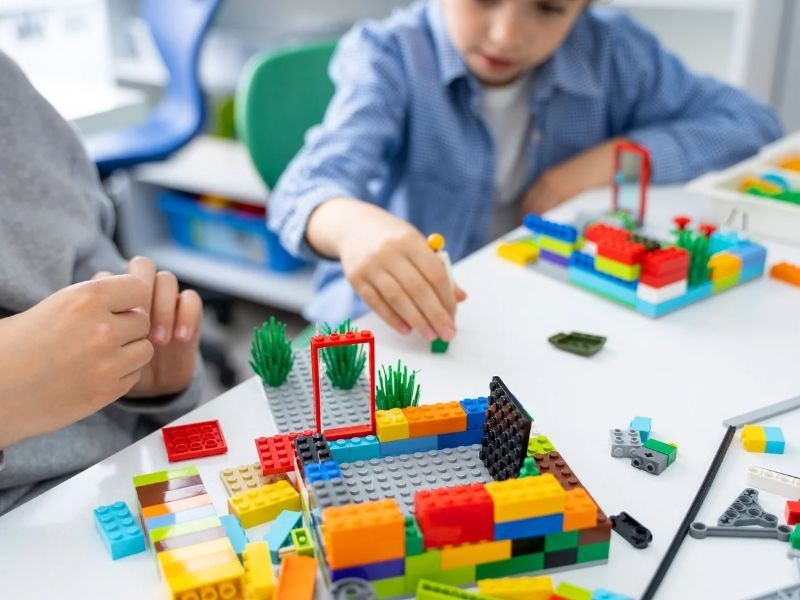
<p>Using LEGO bricks in an educational project allows <strong>students to take a more active role</strong> in their learning. Instead of simply receiving information, they can build their own representations, try different solutions and modify their creations when something does not work. This helps <strong>connect theoretical content with practical examples</strong> and makes the learning process more engaging.</p>
<p>Another important aspect is the development of<a href="https://madeofbrick.com/en/module/owlblog/post?id_owl_blog_post=88&category_parent=1-proyectos-creativos-piezas"> skills such as <strong>creativity</strong></a><strong>, organisation and problem-solving.</strong> To complete a build, students need to think about which pieces they need, how they are going to put them together and what changes they can make to achieve the expected result. <strong>Patience is also encouraged</strong>, as some models take time and several attempts to complete.</p>
<p>Furthermore, these activities <strong>provide opportunities to work as a team.</strong> When several students take part in the same build, they have to divide tasks, share materials and agree on how to develop the project. In this way, LEGO bricks are not only useful for working on specific subjects, but also for improving communication and learning to respect other people's ideas.</p>
<h2>Building LEGO models for educational projects: areas of application</h2>
<p><strong>Building LEGO models can be incorporated into different subjects and activities.</strong> The theme and level of difficulty will depend on the project's objectives and the age of the participants. Here are some areas where this approach can be particularly useful:</p>
<h3>Science and the environment</h3>
<p>These builds make it possible to represent <strong>elements of nature, ecosystems, structures of the human body and phenomena related to the environment</strong>. For example, students can create a model of an ecosystem to identify its components and explain how they are connected.</p>
<p>They can also represent different <strong>natural environments</strong> or develop projects related to environmental protection.</p>
<h3>Technology and engineering</h3>
<p>This is one of the areas where these builds offer the most possibilities. Students can <strong>design vehicles, machines, bridges or small mechanisms</strong> to understand basic concepts of how things work and how structures are built.</p>
<p>They can also <strong>create prototypes, check whether their designs meet the intended objective and make changes</strong> to improve the result. In more advanced projects, the builds can be combined with mechanical or electronic components.</p>
<h3>Mathematics</h3>
<p>LEGO bricks can be used to explain concepts such as <strong>fractions, proportions, symmetry and basic mathematical operations</strong>. For example, they make it possible to show visually how a unit is divided into equal parts or how different quantities are related. This helps students understand mathematical concepts that can sometimes be more difficult to grasp when they are only explained theoretically.</p>
<h3>Art and visual expression</h3>
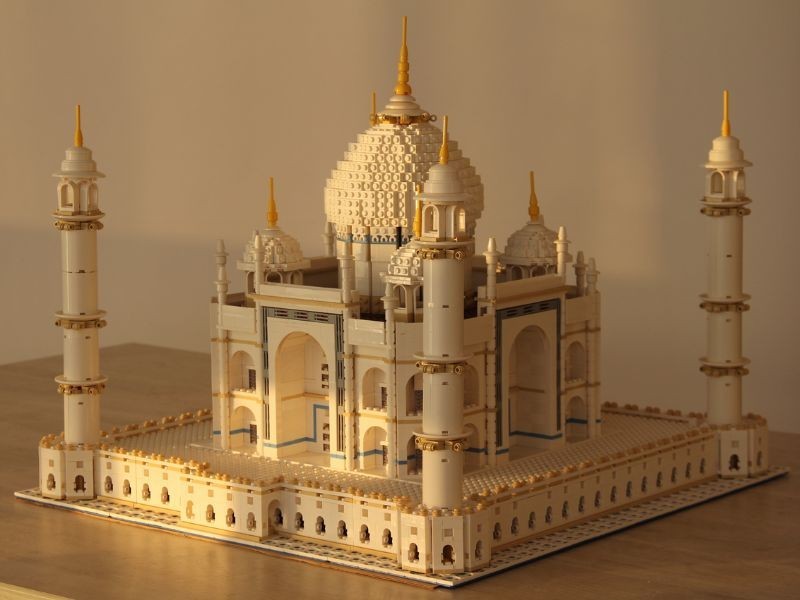
<p>Building models also has a place in artistic activities. Students can reproduce buildings, monuments and everyday objects, or create their own compositions using different colours and shapes. These types of projects help <strong>develop observation skills, the arrangement of elements and creativity</strong>, while allowing each participant to explore their own ideas.</p>
<h2>Choose a LEGO model for educational projects</h2>
<p>Choosing a suitable model depends on <strong>the subject being explored and the objectives of the activity</strong>. Representing a<a href="https://madeofbrick.com/en/3-famous-monuments"> historical monument</a> is not the same as building a vehicle or<a href="https://madeofbrick.com/en/module/owlblog/post?id_owl_blog_post=84&category_parent=1-replicas-arquitectonicas"> recreating an architectural structure</a>. For this reason, it is important to consider the level of difficulty, the number of pieces and the time available to complete the build. It is also worth considering whether the model will be used as part of an individual activity, a group project or a school exhibition.</p>
<p>At <strong>Madeofbrick</strong>, we offer different<a href="https://madeofbrick.com/en/module/owlblog/post?id_owl_blog_post=80&category_parent=1-que-son-piezas-lego"> <strong>LEGO MOC models</strong></a> and the possibility of designing custom models based on each customer's ideas. As an<a href="https://madeofbrick.com/en/"> <strong>online LEGO MOC store</strong></a>, we work with original LEGO pieces and can create builds of monuments, buildings, vehicles and other designs that are not available in our catalogue.</p>
<p>If you have an idea for an educational project, you can contact us and tell us what you would like to represent.</p>
©Copyright 2021 right by madeofbrick


